For infrastructure contractors in Java, buying a concrete batching plant is not just about choosing the highest production capacity. The real challenge is deciding how to supply concrete efficiently across multiple construction projects while controlling equipment investment, transportation, installation, and operating costs.
Consider a contractor handling recurring road construction, bridge foundations, drainage systems, industrial estate development, and municipal infrastructure projects in West Java, Central Java, or East Java. Some projects may run for several months at one location, while others require the contractor to move equipment between construction sites. In this situation, should the company invest in a 50 m³/h stationary concrete batching plant or a 60 m³/h mobile batch plant?
At first glance, the 60 m³/h mobile option seems more attractive because it offers higher rated production capacity and greater relocation flexibility. However, a stationary plant may provide better long-term value when the contractor has a stable project base and regularly produces large concrete volumes in one area.
The better investment depends on project continuity, total concrete demand, site distribution, relocation frequency, and equipment utilization. This comparison examines both options from the perspective of contractors who need a reliable concrete production solution for recurring infrastructure work in Java.
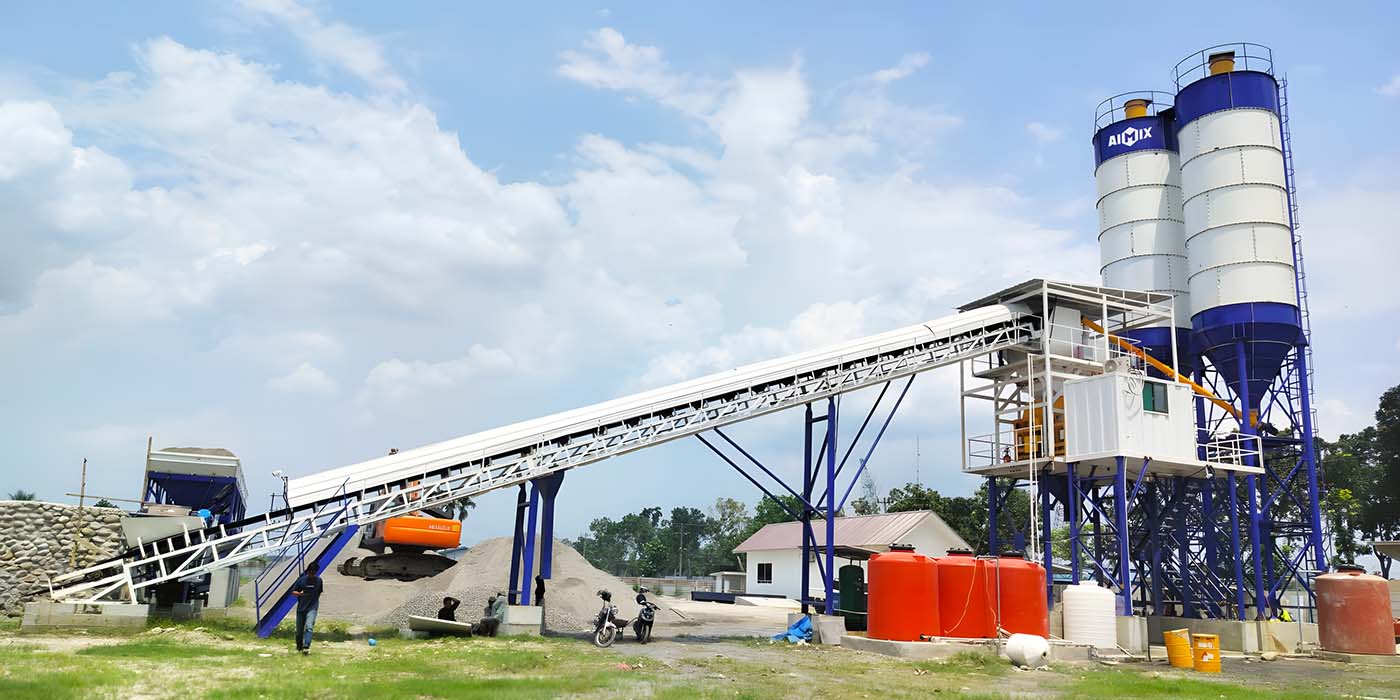
Why Recurring Infrastructure Projects Require a Different Batching Plant Investment Strategy
Contractors working on a single construction project can select equipment according to that project’s duration and production requirements. However, companies handling multiple infrastructure contracts need to consider a longer investment period.
For example, a contractor may complete a road improvement project in Bekasi, move to a drainage project in Karawang, and then undertake bridge construction in Bandung. Another contractor may repeatedly work on industrial facilities around Surabaya, Gresik, and Sidoarjo.
Although both companies operate in Java, their concrete supply requirements can be very different. Therefore, the investment decision should reflect the actual structure of their project pipeline.
Project Continuity Determines Equipment Utilization
A batching plant creates value when it produces concrete consistently. If the contractor has several projects in the same region, a stationary plant can serve as a central production facility. It may supply concrete to different construction sites through transit mixer trucks.
However, when projects are geographically dispersed, transporting fresh concrete over long distances can create scheduling and quality challenges. A mobile plant allows the contractor to establish production closer to the active construction site.
Consequently, the first question should not be whether the contractor has one or five projects. It should be whether those projects share a practical concrete supply location.
Java’s Construction Environment Influences Equipment Selection
Java has a combination of dense urban areas, industrial zones, established transportation networks, and regional infrastructure development. These conditions create different equipment requirements.
- West Java: Road construction, industrial estates, residential development, and infrastructure projects around Bekasi, Karawang, Bandung, and Cirebon.
- Central Java: Regional roads, bridges, drainage improvements, industrial development, and projects connecting cities such as Semarang, Solo, and Purwokerto.
- East Java: Industrial facilities, port-related infrastructure, road construction, and urban development around Surabaya, Gresik, Sidoarjo, and Malang.
In major urban and industrial areas, land availability, truck access, traffic restrictions, and local environmental requirements can affect plant installation. Meanwhile, projects along longer road corridors may require equipment that can move as construction progresses.
50 m³/h Stationary vs. 60 m³/h Mobile Batching Plant: What Is the Main Difference?
Before comparing investment costs, contractors should understand how each plant supports a different production strategy. The difference is not simply 10 m³/h of rated capacity. It involves the entire concrete supply arrangement.
50 m³/h Stationary Concrete Batching Plant
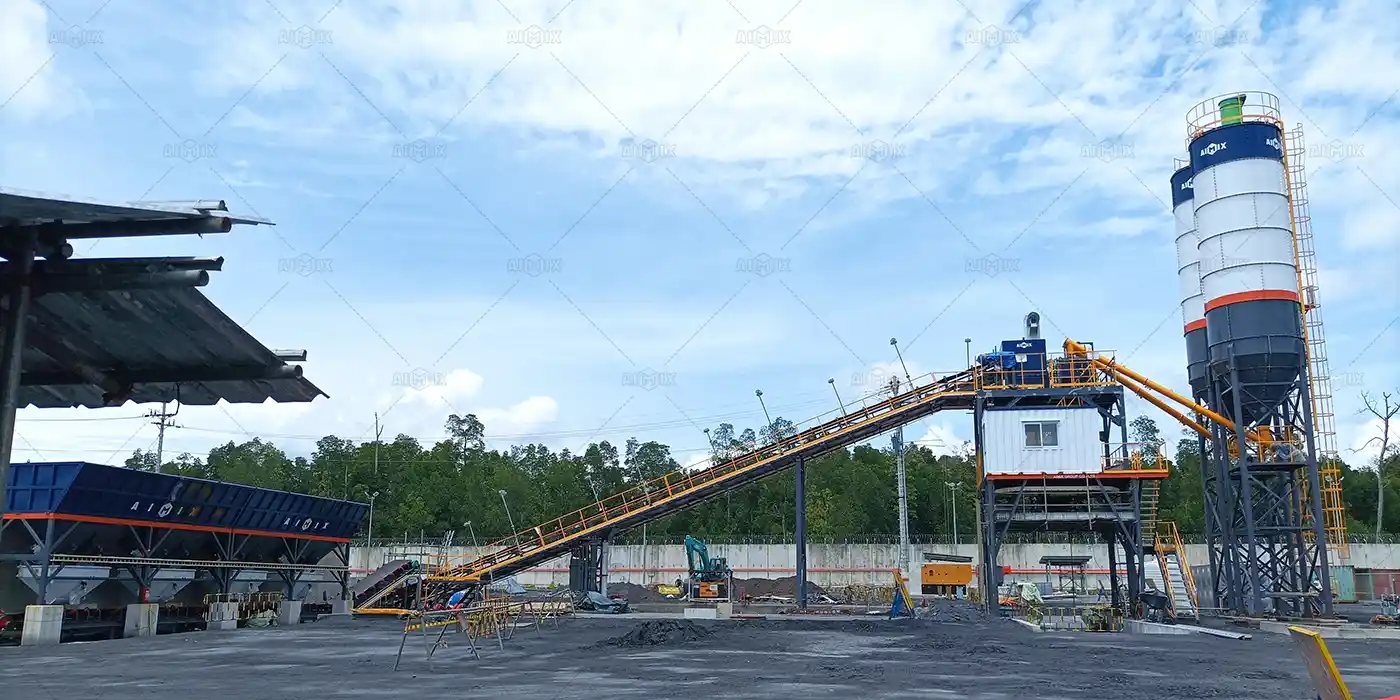
A 50 m³/h stationary concrete batch plant is designed for continuous operation at a relatively stable location. Contractors can organize aggregate storage, cement silos, water supply, electrical connections, and concrete dispatch around a permanent production layout.
This configuration is particularly useful when the company has recurring projects within a reasonable delivery radius. Instead of moving the production equipment after every contract, the contractor can maintain one production base and coordinate concrete transportation to different sites.
Its main advantages include:
- Stable production arrangements for long-term operation.
- Organized aggregate and cement storage.
- Suitable integration with a fleet of transit mixer trucks.
- Potential to serve multiple construction projects from one location.
- More predictable production planning when demand remains consistent.
However, a stationary plant requires a suitable installation location. Contractors must consider land preparation, foundations, utility connections, access roads, local permits, and the cost of transporting concrete to each project.
60 m³/h Mobile Concrete Batching Plant
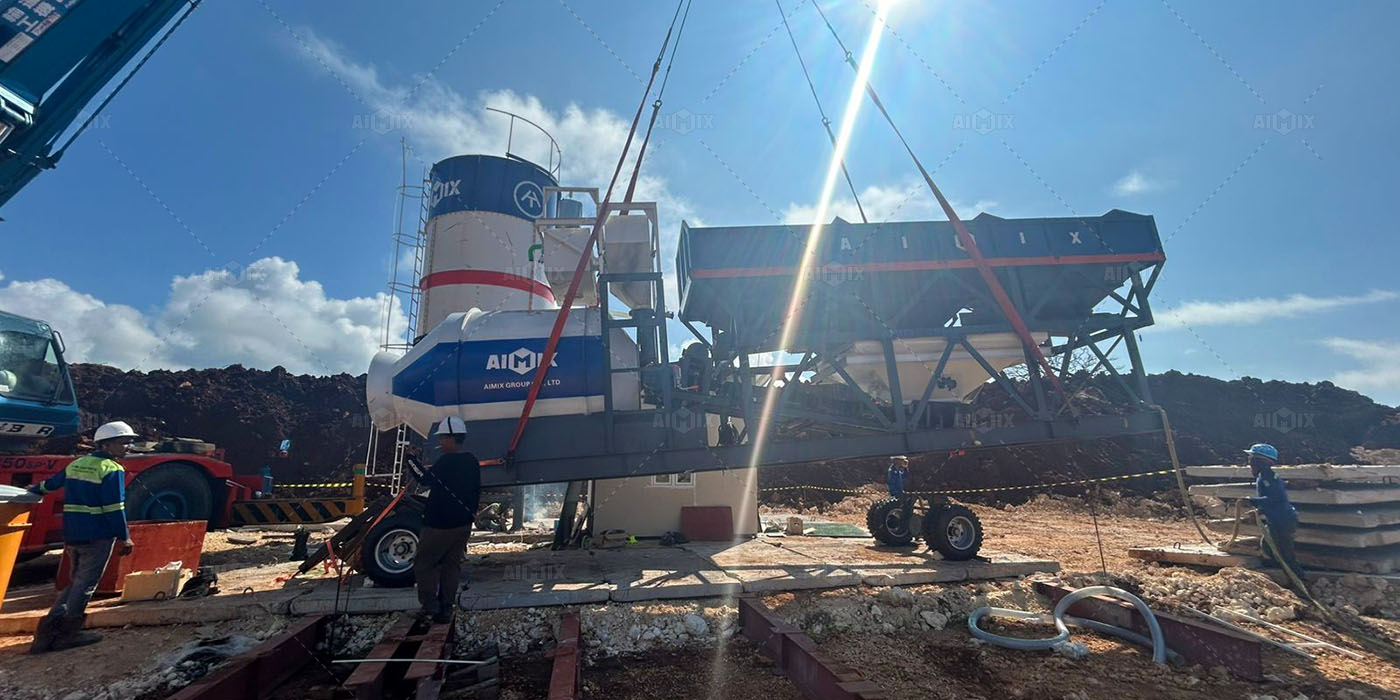
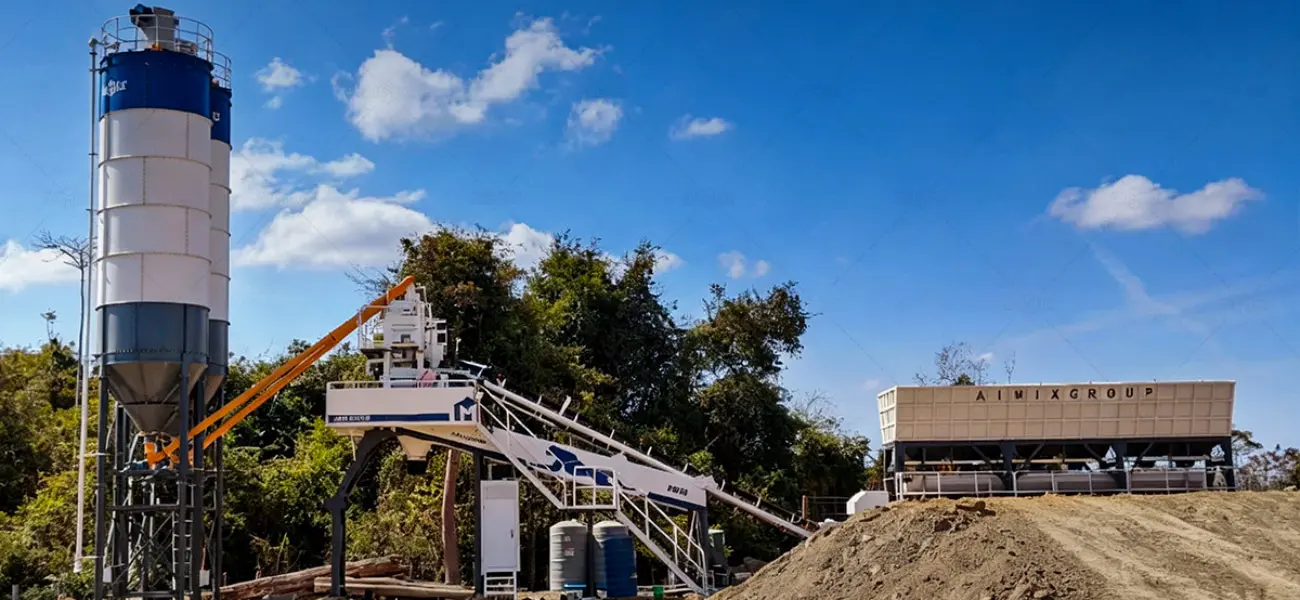
A 60 m³/h mobile batching plant focuses on production flexibility. Its configuration supports relocation between construction sites, allowing contractors to move the concrete production base when project requirements change.
This can be particularly useful for road construction, bridge projects, regional infrastructure development, and contracts with several work sections located far apart.
Its main advantages include:
- Higher rated output than the 50 m³/h stationary option.
- Greater flexibility when construction locations change.
- Potentially shorter mobilization arrangements between suitable sites.
- On-site concrete production closer to active construction areas.
- Reduced dependence on long-distance fresh concrete transportation.
Nevertheless, mobile does not mean installation-free. Contractors still need to arrange transportation, site preparation, assembly or connection, commissioning, material storage, and utility access. The actual relocation time depends on the plant configuration and site conditions.
Production Capacity: Is 60 m³/h Worth the Additional Investment?
Capacity is an important purchasing factor, especially when infrastructure projects require large concrete volumes within limited working hours. However, contractors should compare actual production requirements rather than relying entirely on the manufacturer’s rated output.
The theoretical difference between the two plants is 10 m³/h. This represents a 20% increase in rated capacity for the mobile option.
Compare Theoretical Daily Production
Assume both plants operate for eight hours per day under ideal conditions.
| Comparison | 50 m³/h Stationary | 60 m³/h Mobile |
|---|---|---|
| Rated capacity | 50 m³/h | 60 m³/h |
| Production in 8 hours | 400 m³ | 480 m³ |
| Production in 10 hours | 500 m³ | 600 m³ |
| Daily capacity difference (8 hours) | 80 m³ | |
| Rated capacity increase | 20% | |
These figures represent theoretical production, not guaranteed daily output. Actual production depends on aggregate feeding, moisture content, mix design, batching cycles, truck availability, maintenance, and site coordination.
For preliminary planning, contractors can also use a 75% operating efficiency assumption:
- 50 m³/h stationary plant: approximately 37.5 m³/h practical output.
- 60 m³/h mobile plant: approximately 45 m³/h practical output.
Over eight hours, these assumptions result in approximately 300 m³ and 360 m³ of concrete, respectively.
Therefore, the mobile plant offers an additional estimated 60 m³ per working day under the same operating assumptions. Whether that additional production creates real value depends on the contractor’s concrete demand and placement capacity.
When Does Higher Capacity Make Financial Sense?
Consider a contractor with an average daily concrete requirement of 250–300 m³. A 50 m³/h stationary plant may already provide sufficient production capacity under a well-organized operating schedule.
However, if the contractor regularly needs 350–400 m³ per day, the 60 m³/h mobile plant provides more production headroom. This can help during large foundation pours, bridge construction, road structures, and overlapping project schedules.
On the other hand, buying a 60 m³/h plant without sufficient concrete demand can increase capital expenditure without generating proportional returns. Higher rated capacity only becomes an advantage when the contractor can use it.
Which Plant Is More Suitable for Recurring Road and Bridge Projects?
Road and bridge contractors often face a different challenge from commercial ready-mix suppliers. Their concrete demand may move along a construction corridor rather than remain concentrated around one production facility.
As a result, the location and movement of the batching plant can influence total project costs just as much as production capacity.
Road Construction: Mobile Equipment Offers Greater Flexibility
Consider a contractor handling road improvement projects across several districts in Central Java. The first section may require concrete production near one work zone, while the next section may be several kilometers away.
If the contractor repeatedly moves between construction locations, a 60 m³/h mobile batching plant can provide a practical advantage. It allows the company to reposition its production base according to the construction sequence.
This arrangement can reduce the distance between concrete production and placement. It may also reduce dependence on external ready-mix suppliers when suitable commercial plants are not nearby.
However, contractors should calculate relocation frequency carefully. Moving the plant too frequently can increase transportation, dismantling, reassembly, commissioning, and downtime costs.
Bridge Construction: Consider Concrete Placement Requirements
Bridge projects often involve concentrated concrete demand during pile caps, abutments, piers, beams, and deck construction.
Some bridge projects operate in isolated locations where existing ready-mix plants cannot provide reliable supply. In these cases, an on-site batching plant can improve production control and reduce dependence on long-distance delivery.
A 60 m³/h mobile plant may suit contractors who move between bridge sections or separate construction packages. However, a stationary plant can also work well when the contractor operates several bridge structures within one established project area.
For both options, the plant must match the required concrete grade, aggregate specifications, continuous pouring rate, and quality control procedures. A higher production rating does not replace proper concrete mix design and testing.
Drainage and Municipal Infrastructure: Evaluate Site Distribution
Drainage channels, culverts, retaining structures, and municipal road improvements often involve several small or medium-sized work zones.
If these projects are concentrated within one city or industrial area, a stationary batching plant may serve as a practical supply center. The contractor can dispatch concrete to different locations using transit mixers.
However, if work zones are widely separated or change frequently, mobile production may provide better logistical flexibility.
When Is a 50 m³/h Stationary Plant the Better Long-Term Investment?
Although mobile equipment offers flexibility, contractors should not underestimate the value of a stable production base. A stationary plant can be a stronger investment when the company has recurring demand within a defined geographic area.
1. You Have Multiple Projects Within One Supply Radius
Suppose a contractor regularly handles infrastructure projects around Bekasi, Karawang, and Purwakarta. If the company can establish a suitable production location that serves these projects efficiently, moving a batching plant between sites may not be necessary.
Instead, one stationary plant can supply several projects through a coordinated transportation system. This arrangement can improve equipment utilization and reduce repeated mobilization expenses.
2. You Have a Stable Concrete Production Schedule
Stationary equipment becomes attractive when the contractor has predictable daily demand. For example, road construction, industrial facilities, and commercial developments may require concrete continuously over several months.
In this situation, the company can organize aggregate procurement, cement deliveries, maintenance, labor shifts, and concrete dispatch around one production base.
3. You Plan to Expand Into Commercial Ready-Mix Supply
A contractor may initially purchase a batching plant for its own infrastructure projects. Later, the company may identify opportunities to supply concrete to nearby developers, subcontractors, or smaller construction companies.
A stationary plant can support this expansion when the location provides suitable market access and sufficient demand. For example, a ready mix concrete mixing plant can form the production foundation of a commercial concrete supply operation.
However, the business plan should also account for transit mixer trucks, customer credit terms, quality control, and competition from existing ready-mix suppliers.
For contractors with this objective, a stationary plant is not merely project equipment. It can become a long-term concrete production asset.
When Is a 60 m³/h Mobile Plant the Better Investment?
Now consider contractors whose projects change location more frequently. Their main challenge is not maintaining one central production facility. Instead, they need to establish reliable concrete production wherever the next contract takes them.
1. Your Projects Are Geographically Dispersed
A contractor may complete a road project in East Java, move to a bridge project in another district, and then undertake infrastructure work in Central Java.
Establishing a permanent batching plant for every project would require substantial capital and land arrangements. A mobile concrete batch plant for sale can allow the contractor to reuse one production system across different contracts.
2. Your Construction Schedule Requires On-Site Production
Some infrastructure projects have strict concrete placement schedules. Long-distance transportation can create delivery uncertainty, especially during traffic congestion or difficult weather conditions.
A mobile plant can establish concrete production closer to the active work area. This gives the contractor more control over material batching and production timing.
3. You Regularly Move Along Long Construction Corridors
Road expansion, highway improvement, and regional infrastructure projects may progress through multiple sections. As construction advances, the original production location may become less convenient.
In this situation, the ability to relocate equipment can become a major operational advantage. Nevertheless, contractors should compare the cost of moving the plant with the cost of transporting concrete from a stationary facility.
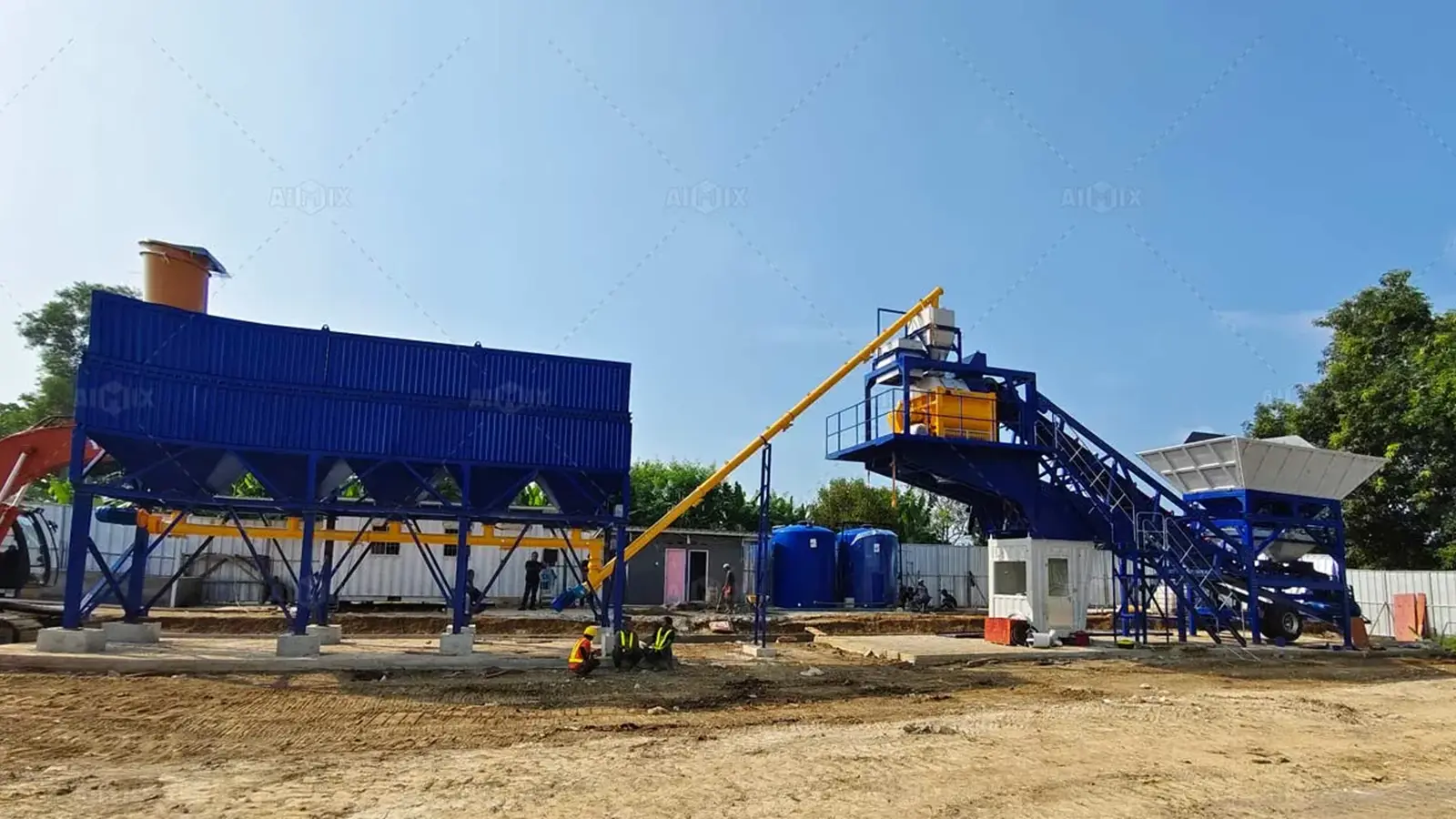
Stationary vs. Mobile: Compare Total Investment, Not Just Purchase Price
One common purchasing mistake is comparing two quotations based only on their equipment prices. The initial purchase price does not represent the total cost of owning and operating a batching plant throughout several infrastructure contracts.
Contractors should calculate the total cost of ownership (TCO) over the expected investment period. When requesting quotations from a batching plant manufacturer, they should also confirm exactly which equipment, installation services, transport arrangements, and after-sales support the quotation includes.
| Cost Factor | 50 m³/h Stationary Plant | 60 m³/h Mobile Plant |
|---|---|---|
| Initial equipment investment | Depends on configuration and automation | Depends on mobile design and configuration |
| Site preparation | Permanent installation requirements | Requirements vary by installation design |
| Relocation costs | Generally higher when moving the complete plant | Designed to support relocation |
| Concrete transportation | May increase when project sites are distant | Can be reduced by moving production closer |
| Production organization | Centralized production and dispatch | Production closer to individual project sites |
| Future utilization | Strong for recurring regional demand | Strong for changing project locations |
| Installation and commissioning | Initial setup at a permanent site | May require setup and commissioning after relocation |
Calculate the Cost of Concrete Transportation
Transportation can significantly affect the economics of both options. A stationary plant may have lower relocation requirements, but its concrete delivery distance can increase when projects are far away.
For example, assume a contractor needs 300 m³ of concrete per day. If the average delivery distance increases substantially, the company may need more transit mixers, longer delivery cycles, and additional dispatch coordination.
A mobile plant may reduce this distance by producing concrete closer to the construction site. However, the contractor must include the cost of moving and reinstalling the batching equipment.
Therefore, compare these two figures:
- Stationary approach: Plant operating costs + concrete transportation + truck fleet costs + delivery-related losses.
- Mobile approach: Plant operating costs + mobilization and relocation + site preparation + local concrete transportation.
The more frequently projects change location, the more important relocation costs become. Conversely, the more concentrated the concrete demand, the more attractive centralized production may be.
How Java’s Site Conditions Affect the Final Decision
Even when two contractors have similar production requirements, their equipment choices may differ because their project locations have different logistical conditions.
Land Availability and Installation Requirements
In dense industrial and urban areas, suitable land can be difficult or expensive to secure. Contractors should evaluate the available space for aggregate storage, cement silos, equipment installation, truck movement, and material delivery.
A mobile plant does not eliminate these requirements. It may simplify relocation, but every new site still needs sufficient working space and proper installation arrangements.
Traffic and Transportation Restrictions
Traffic congestion around Jakarta, Bekasi, Bandung, and Surabaya can affect both raw material delivery and fresh concrete transportation.
A stationary plant may work well when it operates outside congested areas and has efficient delivery routes. However, a mobile plant can be useful when concrete production needs to move closer to changing construction locations.
Rainfall and Material Storage
Java’s rainy season can affect aggregate moisture, stockpile management, site access, and daily production schedules.
Regardless of plant type, contractors should prepare suitable aggregate storage, drainage, moisture measurement, and water correction procedures. These measures help maintain consistent concrete quality during changing weather conditions.
Local Permits and Environmental Requirements
Contractors should also check local requirements before establishing a production site. These may include land-use approval, environmental obligations, dust and noise management, wastewater arrangements, and vehicle access restrictions.
A permanent production location requires long-term site planning. A mobile plant may require additional coordination whenever it moves to a new location. Therefore, the regulatory and site preparation costs should form part of the investment comparison.
Which Option Provides Better ROI Across Multiple Projects?
The return on investment depends on how frequently the equipment operates and how much concrete it produces throughout its useful life.
For recurring infrastructure contractors, it is better to evaluate the investment across several contracts rather than calculate profitability based on one project alone.
Example A: Contractor With Recurring Projects in West Java
Assume a contractor regularly handles road improvements, drainage construction, and industrial infrastructure around Bekasi and Karawang.
The projects have relatively stable concrete demand, and the company can establish one suitable production base within the service area.
In this situation, a 50 m³/h stationary plant may offer better long-term economics. The company can maintain a consistent production location, organize aggregate and cement supply, and distribute concrete to multiple projects.
Because the plant does not need frequent relocation, the contractor can focus on improving production efficiency and maintaining high equipment utilization.
Example B: Contractor Handling Road Projects Across Java
Now consider a contractor that wins infrastructure contracts in different districts across West Java, Central Java, and East Java. Each project lasts several months, but the next contract may be far from the previous one.
A 60 m³/h mobile plant may be more attractive because the company can reuse its production equipment at different construction locations.
The additional rated capacity also provides more production flexibility during peak construction periods. However, the company must ensure that each project generates enough concrete demand to justify mobilization and relocation costs.
Example C: Contractor Expanding Into Concrete Supply
Another contractor may want to develop a concrete supply business alongside its infrastructure construction activities.
In this case, a stationary plant may provide a stronger foundation for long-term operations, particularly when the company has access to a suitable location and a stable customer base.
The company can gradually expand its delivery network and serve several nearby projects instead of moving the production facility after every contract.
What Should Contractors Prepare Before Requesting a Batching Plant Quotation?
After identifying the preferred plant type, contractors should prepare their project information before contacting equipment manufacturers. This helps suppliers recommend a configuration that matches the actual construction requirements.
Project and Production Information
- Current and upcoming project locations in Java.
- Project types, such as roads, bridges, drainage, or industrial infrastructure.
- Estimated concrete demand per day and per month.
- Peak hourly production requirements.
- Expected working hours and project duration.
- Number of projects that will operate simultaneously.
- Required concrete grades and mix designs.
Site and Equipment Requirements
- Available installation area and site access conditions.
- Whether the plant will remain in one location or move between projects.
- Aggregate storage and cement silo requirements.
- Available electricity and water supply.
- Required aggregate feeding and concrete discharge arrangements.
- Transportation restrictions and relocation requirements.
Commercial and After-Sales Considerations
- Total equipment investment budget.
- Installation and commissioning arrangements.
- Operator training and maintenance support.
- Spare parts availability and delivery arrangements.
- Warranty terms and technical service response.
- Possibility of expanding production capacity in the future.
These details help manufacturers compare both plant types more accurately. They also prevent contractors from purchasing a higher-capacity plant that does not match their actual project requirements.
Final Recommendation: Stationary or Mobile for Java Infrastructure Contractors?
There is no universal winner between a 50 m³/h stationary batching plant and a 60 m³/h mobile batch plant. Both can support recurring infrastructure projects, but they serve different operational strategies.
A stationary plant is generally more attractive when the contractor has a stable project pipeline within one region, predictable concrete demand, and a suitable long-term installation location.
A mobile plant is generally more attractive when construction locations change frequently, projects are geographically dispersed, and on-site concrete production can reduce transportation and supply risks.
| Your Business Situation | Recommended Option to Evaluate First |
|---|---|
| Recurring projects around one industrial or urban region | 50 m³/h Stationary |
| Long road construction corridors | 60 m³/h Mobile |
| Multiple projects with stable central concrete demand | 50 m³/h Stationary |
| Frequent relocation between districts | 60 m³/h Mobile |
| Commercial ready-mix supply expansion | 50 m³/h Stationary |
| Remote bridge and infrastructure construction | 60 m³/h Mobile |
For some larger contractors, combining both configurations may also make sense. A stationary plant can handle stable regional demand, while a mobile unit supports temporary projects and remote construction sections. This approach requires sufficient project volume and careful coordination, but it can provide greater flexibility across a broader operating area.
Get the Right Batching Plant for Your Next Infrastructure Contract
Choosing between a 50 m³/h stationary plant and a 60 m³/h mobile plant should start with your project pipeline, not simply the equipment specification sheet.
At AIMIX, we help contractors evaluate concrete production solutions according to project location, required capacity, installation conditions, construction schedules, and long-term investment objectives. Whether you are building roads in West Java, bridges in Central Java, or industrial infrastructure in East Java, selecting the right configuration can help improve production control and manage concrete supply costs.
Planning to invest in a concrete batching plant for recurring projects in Java? Contact the AIMIX team and share your project locations, daily concrete demand, expected project duration, and relocation requirements. We can help you compare a 50 m³/h stationary batching plant with a 60 m³/h mobile batching plant and identify the solution that best fits your construction business.